
Reviewed · FORBIDDEN CITY & TIANANMEN VISITS
In-depth Forbidden City tour with Royal Icehouse Lunch
The Forbidden City feels personal on this tour. You get a private guide and a Royal Icehouse lunch built into the day, plus access to extra spaces beyond the usual highlights. One consideration is that you’re still looking at a solid half-day of walking, so wear comfortable shoes and plan for some steady stairs and uneven surfaces.
You start at 7:30 am and enjoy hotel pickup and drop-off, which makes the whole thing simpler than trying to coordinate trains, taxis, and timed entry on your own. The upside here is value, because admission fees and lunch are both included in the $150 per person price.
Key tour takeaways
- Royal Icehouse lunch during the visit gives you a real break in the middle of palace sightseeing
- Private guide pacing works well if you need a slower rhythm, including families and older visitors
- More than the main halls includes Imperial Library and Treasure Rooms (Antiquarium) themes
- South Gate and Meridian Line help you understand the layout and why it matters
- Nine Dragon Screen and garden symbolism add visual variety beyond buildings alone
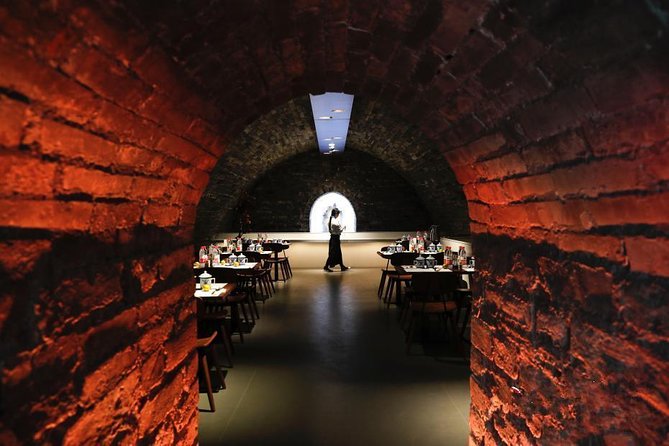
Royal Icehouse lunch inside the Forbidden City grounds
The lunch is not just a meal, it’s part of the experience. The Forbidden City can be dry and exhausting when you treat it like a checklist, so I like that you get a planned pause with Royal Icehouse lunch. In practice, that timing helps you keep your energy for the afternoon highlights, and it also breaks up the heat and crowd pressure that can build later in the day.
One detail I’d plan around: because lunch is included inside the former Icehouse setting, you’re not stuck hunting for food outside the palace walls mid-tour. A guide named Selina was especially praised for making that lunch moment feel like a one-time opportunity, not an afterthought. Another theme in the feedback is that the food itself hits the sweet spot, tasty enough that the pause feels worthwhile rather than rushed.
If you’re traveling with kids or an older guest, this lunch stop matters even more. Lily, for example, was highlighted for pacing carefully through the day, and the meal break helps keep that pace sustainable.
You can also read our reviews of more city tours in Beijing


The 7:30 am private rhythm, plus hotel pickup that actually helps
This tour runs about 6 hours, starting at 7:30 am. That early start is practical. You get into the palace before the day turns into a marathon, and it makes sense for a site as big as this one. Also, the day is private, meaning it’s only your group, not a mixed crowd you have to dodge or keep up with.
Hotel pickup and drop-off are included, which saves you from the usual Beijing logistics headache. When your guide meets you at the start time and handles the return, you can spend your brainpower on the history and layout, instead of street-finding and timing.
You’ll also use a mobile ticket. That’s convenient on a day when you might be juggling phones, water bottles, and camera batteries.
How the Forbidden City stops connect, from gates to inner court
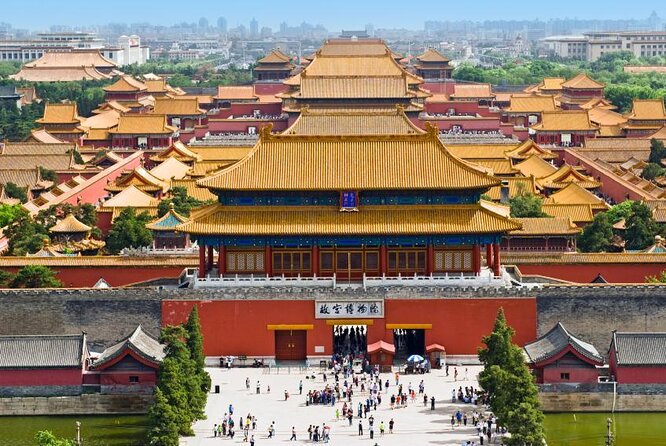
The best Forbidden City tours are the ones that make you feel the layout, not just name the buildings. This one does that by moving through the palace in a way that ties together entrances, ceremony space, administration space, and the residential areas.
South gate and the Meridian Line idea
You begin with the South gate, the main entrance. This gate is tied to how the emperor viewed the palace axis, including the belief that the Meridian Line ran right through it. I like this kind of detail because it turns the place from a maze into a plan you can follow with your eyes.
You’ll also learn how the site’s positions and alignments were meant to communicate order and power. Even if you only catch it once in the guide’s explanation, it helps you recognize what you’re looking at as you move deeper.
Defensive corners, then straight into the ceremonial core
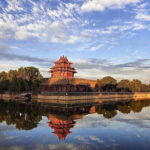
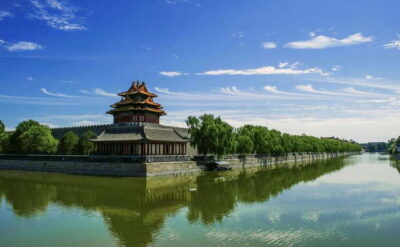
Before you hit the biggest ceremony spaces, you’ll also encounter a defensive construction segment at a corner of the wall. If that wall area is open, you get inside one of them. That small detour is useful because it reminds you that the Forbidden City is not only about aesthetics. It was built with protection in mind too, and that changes how you read the surrounding walls and gates.
After that comes the main sweep into the palace’s core.
A few more Beijing tours and experiences worth a look
The ceremony hall, exam-era banquets, and daily administration buildings
In a typical visit, people rush the grand halls, take photos, and move on. Here, the descriptions are aimed at function. That makes each stop easier to understand, because you know what happened there and why it had to be in that exact spot.
The main ceremony hall and what it signals
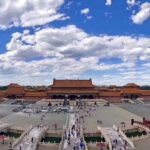
One of your key stops is the most important building in the Forbidden City, described as the largest wooden structure in the world, where the emperor worked and held major ceremonies. When a guide frames a hall this way, you stop looking only at the size and start noticing the message the architecture is designed to send.
I’d think of this as the palace’s public face. You’re standing in the kind of space where the city’s authority was staged for visibility.
Banquets and imperial examinations
Next, you’ll visit a hall used for banquets, and later tied to imperial examinations, which tested candidates’ understanding of classical and Confucian literature under the emperor’s supervision. This is one of the stops I like best, because it shows the palace was not only for spectacle. It was also where the state tested and shaped its future leaders.
If you’ve ever wondered how education and government were connected in traditional China, this stop turns that idea from abstract to concrete.
Daily affairs and the emperor’s living quarters
Then the tour shifts toward the emperor’s daily world, including a place where he handled daily affairs and lived with the empress and imperial concubines. That change in tone is important. It reminds you that this was a working space with real routines, not only a ceremonial stage.
Later, you also visit the largest building in the inner court, the emperor’s residence. Together, these inner stops help you understand the separation between performance and private life, even within the same complex.
Treasures, imperial theatre, and the Antiquarium-style rooms
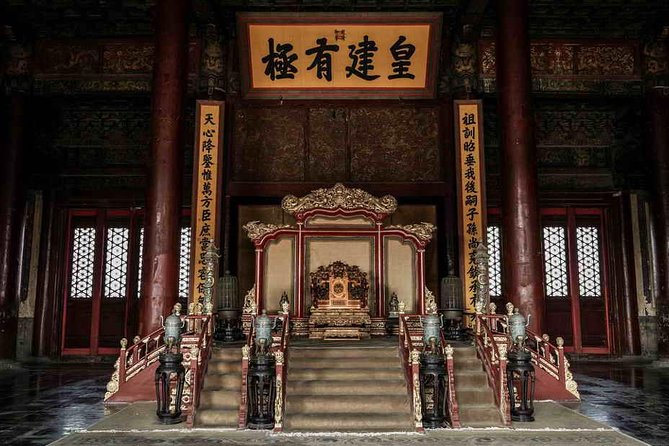
The Treasure Rooms, also called the Antiquarium, are where your visit gets more interesting for modern minds. Instead of only looking at buildings, you’re guided into theme exhibition spaces where you can see how the palace tells stories with artifacts and curated displays.
Your tour also includes the Imperial Library, which adds another layer beyond the big rooms and courtyards. For me, that’s the value of doing an organized private tour rather than walking through on your own. A guide can help you connect the dots between government, scholarship, and how rulers collected and preserved objects and texts.
One especially detailed part is Treasure Hall. It is made of several buildings built for the abdicated Emperor Qianlong, and it functions as exhibition areas with multiple theme halls, tied to an imperial theatre setting. That combination matters. You’re not just seeing a museum room. You’re stepping into a space that was designed for power and culture, with a structure that reflects changing dynastic needs.
If you like your sightseeing to include context, this is where you’ll likely feel the most satisfied. The guide explains not just what you’re seeing, but how the spaces were repurposed and staged over time.
The Nine Dragon Screen and garden symbolism that you can actually spot
After the Treasure Hall area, you’ll see a Nine Dragon Screen nearby. It’s one of three Nine Dragon Screens in China. The other two are mentioned as being in Beihai Park and Datong. You also learn that the nine dragons engraved on the screen have different colors.
I like this kind of stop because it’s visually specific. Even if you forget dates and reigns later, you’ll remember dragons. More importantly, you’ll understand that these decorative elements were not random. They were part of how authority was expressed.
Then the tour moves into a rectangular garden area containing more than 20 different types of buildings, pavilions, terraces, towers, and rockeries. You’ll also see four pavilions in the garden that symbolize the four seasons. This is a helpful contrast after halls and screens. You can slow your pace, use the guide’s descriptions to find patterns, and feel like you’re exploring something designed for reflection rather than ceremonies.
Private guide impact: Lily, Selina, Angie, Shanshan, and Helen Zhang
This tour’s rating is high for a reason: the guide makes the difference. The common theme is attention to pacing and clarity, not just reciting facts.
- Lily stood out for accommodating an elderly guest, patiently pacing through the palace so nobody felt rushed or left behind.
- Selina was praised for hotel pickup punctuality and for making the Royal Icehouse lunch feel like a special moment within the grounds.
- Angie was highlighted for contacting guests the day before to confirm timing and being punctual, which reduces that pre-tour stress.
- Shanshan earned strong marks for ensuring there was plenty of time to see important buildings.
- Helen Zhang was praised for making the history and culture understandable for the whole group, including kids, while still covering the key buildings effectively.
When you pick a private tour, you are buying that human factor. If you hate being herded, you’ll feel more in control here.
Practical tip: if you have any special needs, mention them up front. This kind of tour works best when the guide knows what pace you’re aiming for.
Price and value: what $150 per person really includes
$150 per person for a 6-hour private Forbidden City visit is not the cheapest way to do this site. But it can be good value because the price includes:
- all entrance fees
- Royal Icehouse lunch
- free hotel pickup and drop-off
- a private guide for your group
- a mobile ticket for smoother entry
That set of inclusions changes the math. If you’ve ever tried to build your own day by paying for ticket access, hiring a guide separately, and figuring out lunch near the palace, it usually adds up fast. Here, you pay once and the schedule is handled.
Also, this is booked about 49 days in advance on average, which tells me it’s a popular slot. If you want a specific date, I’d treat that as a small clue to reserve early rather than waiting.
Who should book this Forbidden City Royal Icehouse tour
I think this is a strong fit if you want:
- a private guide who helps you understand the palace layout and building purpose
- more than just the headline sights, including Imperial Library and Treasure Rooms
- lunch planned into the experience at Royal Icehouse
- a pace that can be adjusted, which matters for older travelers or families
It may not be ideal if you want a totally relaxed, minimalist walk where you drift at your own pace with zero structure. This is still a half-day of active sightseeing, and the tour calls for moderate physical fitness.
Should you book it?
If your goal is a guided, well-paced Forbidden City day with lunch built in, I’d book this. The Royal Icehouse lunch changes the feel of the visit, and the access to Imperial Library and Treasure Rooms adds depth beyond the usual main-hall photo run.
If you’re traveling with someone who gets tired easily, this is also one of the better options because the guide approach is repeatedly described as patient and accommodating. Just go in with the mindset that you’re spending about 6 hours walking, learning, and shifting between ceremonial and inner-court areas.
FAQ
What time does the Forbidden City tour start?
The tour start time is 7:30 am.
How long is the tour?
It runs about 6 hours (approximately).
Is hotel pickup and drop-off included?
Yes, free hotel pickup and drop-off are included for convenience.
What is included in the $150 price?
The price includes all entrance fees and lunch at the former Icehouse (Royal Icehouse lunch).
Is this tour private?
Yes. It is a private tour, so only your group participates.
Do I need passport details when booking?
Yes. The passport name and number are required at the time of booking for all participants.
Is there a fitness requirement?
Yes. Travelers should have a moderate physical fitness level.
Is free cancellation available?
Yes. You can cancel up to 24 hours in advance for a full refund.
More City Tours in Beijing
More Tours in Beijing
More Tour Reviews in Beijing
Not for you? Here's more nearby things to do in Beijing we have reviewed


Forbidden City & Tiananmen Visits, compared.
 ★ 4.8Forbidden City Tour(Group/Private)-Tickets IncludedFrom $47,974 reviews
 ★ 4.8T-Square & Forbidden City Group or Private TourFrom $174,446 reviews
 ★ 5.0All-Inclusive Tour: Tiananmen Square, Forbidden City, Great WallFrom $1282,873 reviews
 ★ 5.04-Hour Small Group Tour to Forbidden City with Entry TicketsFrom $151,863 reviews
 ★ 4.5Tiananmen Square Registration Service(Ticket)From $31,704 reviews
 ★ 5.0Beijing Full Day Tours: Tiananmen Sq, Forbidden City, Great WallFrom $991,634 reviews
 ★ 4.6Tianmen Square, Forbidden City & Royal Museum ToursFrom $41,288 reviews
 ★ 5.0Beijing Forbidden City Ticket Booking (Optional: guide service)From $91,263 reviews
Browse the lists this tour appears in