
Reviewed · FORBIDDEN CITY & TIANANMEN VISITS
Imperial Secret-Forbidden City and Jingshan Park Small Group Tour
Skip the queue, feel the palace breathe. Prebooking gives you guaranteed entry to the Forbidden City, and a small-group pace keeps the day calm instead of chaotic.
You also get to choose a morning or afternoon start, so you can shape the rest of Beijing around this 4-hour outing. The payoff is practical too, you’ll finish at Jingshan Park for a classic Forbidden City view from the summit, often the easiest place to get those big-picture photos.
One thing to plan around, there is no hotel pick-up or drop-off. You’ll meet at Hotel Kapok Beijing and your tour ends at Jingshan Park, so you’ll want to line up your transport on both ends.
Key highlights you’ll feel right away
- Guaranteed entry to the Forbidden City with prebooking, so you’re not stuck hoping for tickets.
- Max 12 people means you can actually hear your guide and stop for photos without rushing.
- Jingshan Park summit views from the Wanchun Pavilion area, a different angle on the palace complex.
- Guide-led context through major spaces like Wumen and the Hall of Supreme Harmony, plus the story of how emperors lived and ruled.
- A reset inside the Palace Museum with the Imperial Garden, so the day doesn’t turn into one long walk.
Why this Forbidden City plus Jingshan combo works
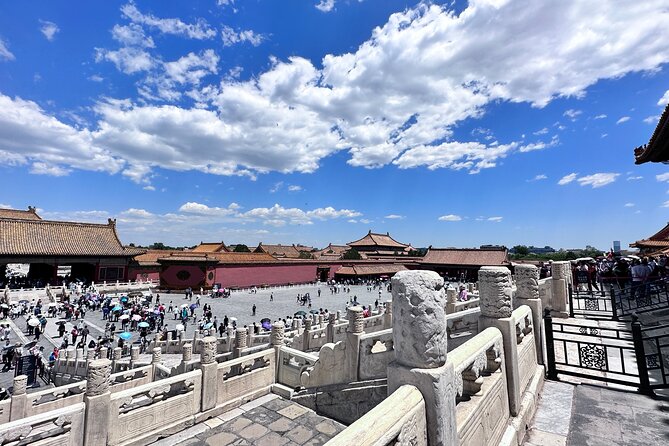
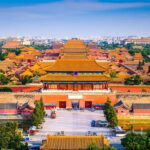
The Forbidden City is famous for a reason. It is huge, heavily signposted, and still tough to navigate on your own without a plan. This tour is built around the reality that you only have a half day, so you need the right route and a guide who can point out what actually matters.
The best value starts with how you enter. With prebooking, your spot is already set for the Palace Museum, so you spend your energy looking, not trying to figure out what’s happening with tickets. Then there is the style of pacing. You’re in a small group (up to 12), which tends to make the whole experience feel more like walking with a friendly expert than getting pulled through a checklist.
You also finish with Jingshan Park, which many people skip or treat as an afterthought. That would be a shame. The park gives you a high viewpoint over the Forbidden City, and it’s one of the most direct ways to understand the layout. Instead of just seeing buildings up close, you start seeing how everything lines up and why emperors built the way they did.
You can also read our reviews of more city tours in Beijing
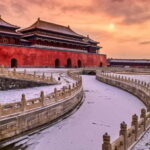
Meeting at Hotel Kapok Beijing, and the time-saver logic
Your meeting point is Hotel Kapok Beijing (16 Dong Hua Men Da Jie). The smart detail here is the way the group meets. You’re not starting from the Tiananmen Square chaos. The meeting spot is chosen to help you bypass the lengthy queues people often hit during Tiananmen security checks.
That matters because delays in that area can snowball. If your day depends on seeing both the Palace Museum and Jingshan Park, time is not something you want to gamble with. A set meeting location also helps the guide keep the group together, especially when you’re moving between key gates and major halls.
Another practical note: the tour ends at Jingshan Park (44 Jing Shan Xi Jie). There is no return to your hotel built into the plan. If you live far away or you’re meeting someone later, this is the kind of detail you want to plan early.
Entering the Palace Museum, then focusing on the main statements of power
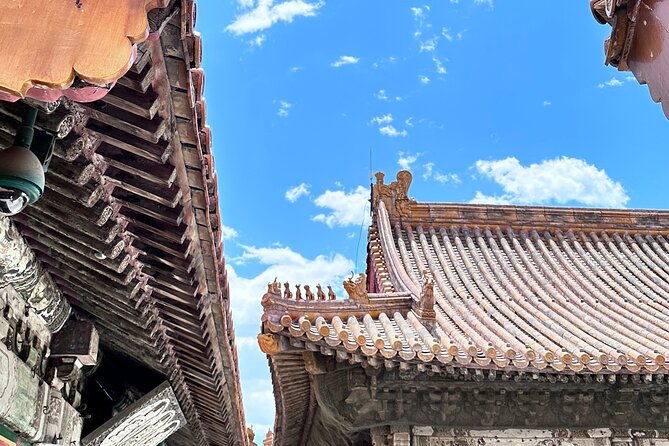
The Palace Museum portion runs about 3 hours, and it’s structured to hit the Forbidden City’s most meaningful spaces without getting lost in the weeds. You’ll start with the southern entrance and move through the ceremonial core before shifting toward the areas that show how rulers lived.
Wumen (Meridian Gate): the southern face of the empire
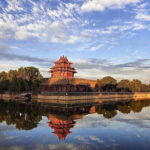
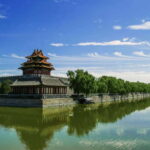
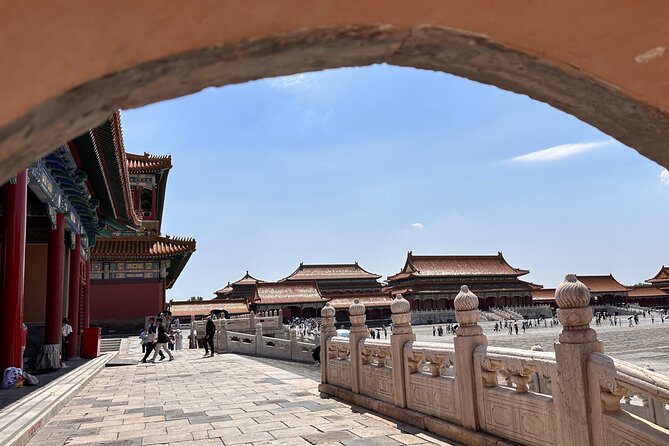
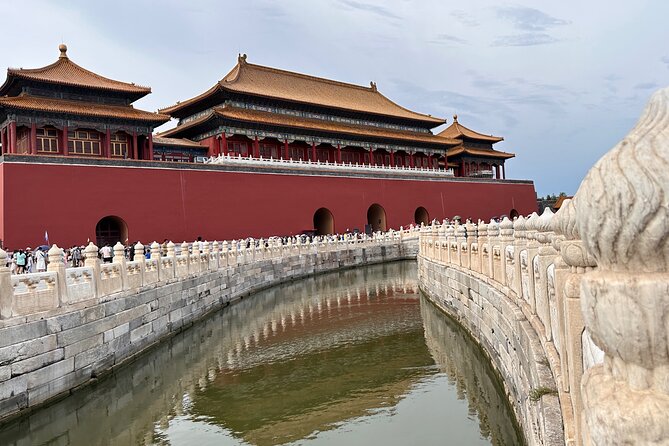
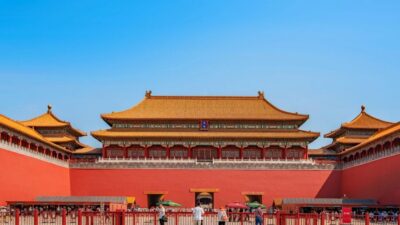
Wumen, also called the Meridian Gate, is the southern entrance to the Forbidden City. The gate is topped with pavilions and marked by intricate carvings. In a guide-led tour, it’s not just a photo stop. You learn what it represents, why it sits where it does, and how entrances were designed to manage who could approach and how.
Look for the overall symmetry and the layers. From ground level, it can feel like a wall. From the right angle, it reads like a statement. A good guide helps you see that the architecture isn’t only decorative, it’s political.
Hall of Supreme Harmony (Taihe Dian): where ceremony happened
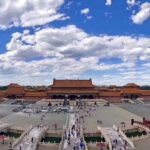
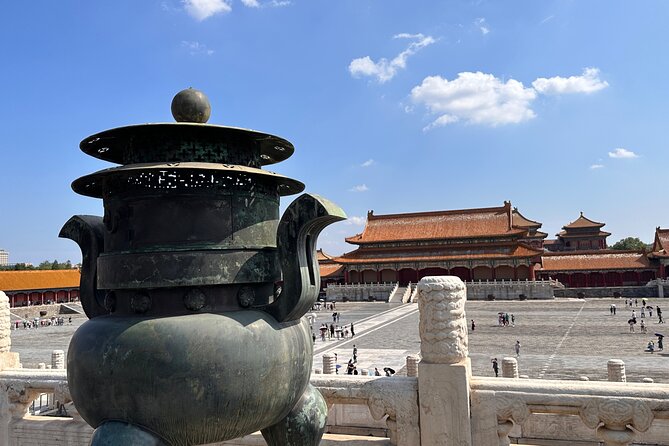
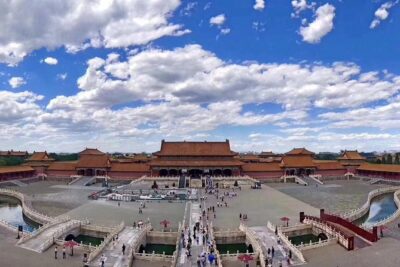
Next is the Hall of Supreme Harmony, the largest and most important building inside the complex. This was the ceremonial center, meaning it’s tied to big state events and the outward image of authority.
What I like about stopping here on a small-group tour is the chance to actually pause and absorb. With a guide, you’re not just trying to translate signs. You’re getting the context for why the hall is so dominant, what you should notice in the design, and how that fits the Ming and Qing worldview.
Qianqing Palace: where leadership becomes daily life
Then you move to Qianqing Palace, also known as the Palace of Heavenly Purity. This is described as the primary residence of emperors during the Ming and Qing dynasties. That one detail changes the tone of the tour. You start thinking less about pageantry and more about routines, responsibility, and the private spaces behind public rule.
Again, you’re not wandering randomly. You’re moving from the empire’s front stage to the spaces that connect to how emperors lived. A guide who explains the meaning of each part can make this shift feel clear instead of confusing.
The Imperial Garden (Yuhua Yuan) reset, and why it matters
After the main ceremonial and residential stops, the tour includes time for the Imperial Garden (Yuhua Yuan) inside the Palace Museum. This is a quieter pocket within the complex, with pavilions and ponds and a design meant for rest.
Even if you love grand halls, this is the stop that keeps the day human. The Forbidden City can feel like an endless sequence of stone, roofs, and formal layouts. The garden breaks that pattern with a different atmosphere, so you can breathe and reset before climbing toward your next big viewpoint.
The Imperial Garden is described as a private sanctuary for emperors and their families. That matters because it adds a layer to what you think the Forbidden City was for. It wasn’t only governing. It was also retreat, family life, and private moments shielded by walls.
Jingshan Park: the climb that turns buildings into a map
After the Palace Museum, you head to Jingshan Park. This part is about 30 minutes, and it’s built for one key goal: getting the best view of the Forbidden City from above.
Jingshan Park sits north of the Forbidden City, and it rises enough that the viewpoint becomes obvious once you reach the top. The highlight is the summit area where Wanchun Pavilion is located. From there, you can capture the sweeping panorama that explains the palace’s layout.
This is also a smart way to end. You’re not leaving with only close-up details. You’re ending with a perspective that helps everything snap into place. If you’ve ever visited a huge complex and later felt like you only saw walls, this is the part that helps you understand the whole design.
Small group size, and why the guide really makes or breaks it
This is one of those tours where the guide is not just a nice bonus. It’s part of the product.
Across the guides named in feedback, you can see a consistent pattern: they help you connect details to meaning. People specifically highlighted guides like Susan and Lily for clear explanations, and Ren and Simon for making the experience easy and informative. That kind of consistency matters because the Forbidden City is packed with elements that look similar until someone tells you what each part is doing.
Here’s what that typically means in real life:
- You get more than a timeline. You get reasons, like why a building is used for ceremony or how a space fits an emperor’s life.
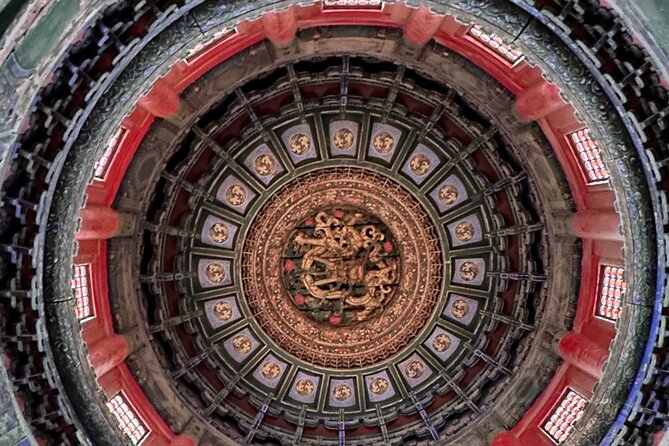
- You’re more likely to notice architectural and decorative details because the guide points your eyes in the right direction.
- You can ask questions without losing the group. With up to 12 people, you’re not stuck waiting for your turn at every stop.
One practical example from feedback is flexibility. A family with a 1-year-old noted the guide accommodated their needs. That is not something you can guarantee on every tour, but in a small group, it’s usually easier to slow down and adjust.
Price and value: what $98 covers, and what it doesn’t
At $98 per person for a roughly 4-hour experience, this tour is priced like a convenience plus interpretation package.
What you get is specific and tangible:
- An expert guide
- Entrance tickets to the Forbidden City
- Entrance ticket to Jingshan Park
- Small group size (up to 12)
- A mobile ticket
If you tried to do this yourself, you would still need entry tickets, you’d still need to figure out an efficient route, and you’d still spend time scanning information while the site fills up around you. The value here is that your guide helps you hit the key spaces in time for the Jingshan viewpoint.
What you do not get:
- Hotel pick-up and drop-off
- Tips to guide (not included)
That last point is a normal travel expectation, but it’s worth remembering so it doesn’t surprise you at the end of the day. Also, since there is no hotel transportation, your true cost depends on how you get to Hotel Kapok Beijing and how you continue from Jingshan Park after the tour.
Morning vs afternoon: how to choose without overthinking it
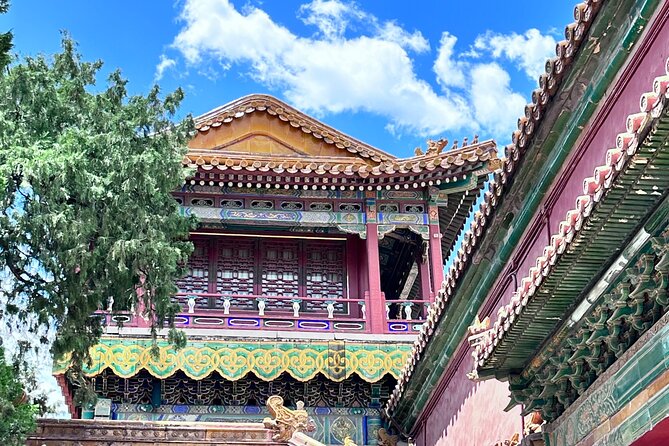
The tour offers a choice of morning or afternoon visits. That flexibility is useful because it helps you match the Forbidden City to the rest of your itinerary.
If you like starting early, a morning slot can help you get your day’s biggest sights done before you’re tired from other stops. If you prefer a later start, an afternoon slot can fit better with morning markets or museums.
The bigger deciding factor is weather. The tour requires good weather, and it can be rescheduled or refunded if conditions are poor. So you’ll want to check the forecast the day before and treat weather as part of your planning, not an afterthought.
What to wear and bring for comfortable walking
The route covers major parts of the Palace Museum plus a climb up Jingshan Park. That means comfort matters more than style.
You’ll be on your feet for a few hours, with time spent stopping for photos and listening for context. Here’s what I’d prioritize:
- Comfortable walking shoes (the ground inside major sites can be uneven)
- A camera or phone with enough battery for the summit viewpoint
- A light layer, since weather can shift as you move between enclosed spaces and open viewpoints
Also, because this is a mobile ticket tour, make sure your phone is ready, charged, and able to show the ticket without hunting through apps at the entrance.
Should you book this tour?
Yes, if you want the Forbidden City without the stress of planning every turn. This works especially well for first-time visitors who want a smart highlight path, a calm pace in a group capped at 12, and a clear finish at Jingshan Park for the skyline view.
Book it if:
- You care about guaranteed entry and hate ticket uncertainty
- You’d rather understand what you’re seeing than just collect photos
- You want a half-day plan that ends with an easy-to-process viewpoint, not a vague blur of buildings
Skip it (or at least compare options) if:
- You need hotel pick-up, or you’d rather have a tour that returns you directly to your lodging
- You plan to spend lots of unstructured time wandering beyond major highlights
If that sounds like your style, you’ll likely appreciate how this tour balances access, pace, and interpretation, then caps it with one of the best photo angles in Beijing.
FAQ
How long is the Imperial Secret-Forbidden City and Jingshan Park tour?
It runs about 4 hours (approx.).
How big is the group for this tour?
The group is limited to a maximum of 12 participants.
Is a morning or afternoon visit available?
Yes, the tour offers a choice of morning or afternoon visits.
What’s included in the price?
The price includes an expert tour guide, entrance tickets to the Forbidden City, entrance ticket to Jingshan Park, and the small group tour.
Where do we meet for the tour?
You meet at Hotel Kapok Beijing, 16 Dong Hua Men Da Jie, Dong Cheng Qu, Beijing, China.
Where does the tour end?
The tour ends at Jingshan Park, 44 Jing Shan Xi Jie, 景山 Xi Cheng Qu, Beijing, China.
Is hotel pick-up or drop-off included?
No. Hotel pick-up and drop-off are not included.
Do I receive a mobile ticket?
Yes, this tour uses a mobile ticket.
What if the weather is poor?
The experience requires good weather. If it’s canceled due to poor weather, you’ll be offered a different date or a full refund.
What is the cancellation policy?
Free cancellation is available. You can cancel up to 24 hours in advance for a full refund. If you cancel less than 24 hours before the start time, the amount paid is not refunded.
More City Tours in Beijing
More Tours in Beijing
More Tour Reviews in Beijing
Not for you? Here's more nearby things to do in Beijing we have reviewed


Forbidden City & Tiananmen Visits, compared.
 ★ 4.8Forbidden City Tour(Group/Private)-Tickets IncludedFrom $47,974 reviews
 ★ 4.8T-Square & Forbidden City Group or Private TourFrom $174,446 reviews
 ★ 5.0All-Inclusive Tour: Tiananmen Square, Forbidden City, Great WallFrom $1282,873 reviews
 ★ 5.04-Hour Small Group Tour to Forbidden City with Entry TicketsFrom $151,863 reviews
 ★ 4.5Tiananmen Square Registration Service(Ticket)From $31,704 reviews
 ★ 5.0Beijing Full Day Tours: Tiananmen Sq, Forbidden City, Great WallFrom $991,634 reviews
 ★ 4.6Tianmen Square, Forbidden City & Royal Museum ToursFrom $41,288 reviews
 ★ 5.0Beijing Forbidden City Ticket Booking (Optional: guide service)From $91,263 reviews
Browse the lists this tour appears in